
The missing piece of higher education's AI response: Adaptive capabilities
Paula de Barba, Monash University
When ChatGPT arrived, higher education did what it does well under pressure. Universities revisited assessment, strengthened academic integrity policies and asked how graduates could continue to demonstrate what they know and can do in a world where AI generates increasingly sophisticated work.
That work mattered, and it is far from over. But I have come to think we reached for the assessment question partly because it was the tractable one. Assessment is visible, regulated, and ours to redesign. The harder question sits underneath it: not how we assure assessment, but how we assure learning itself.
That question is at the heart of Assuring Quality Learning in a GenAI-Integrated Future, a paper commissioned by TEQSA that I recently co-authored with colleagues from across the sector. Rather than asking how students should use today’s AI tools, we asked what will still matter when today’s tools are gone: which capabilities will enable graduates to keep learning effectively, ethically and independently as the technology continues to change?
The answer is not better prompting.
One observation kept resurfacing across our work: students who learn and think well with AI are generally effective learners and ethical thinkers first.
Reading that as a deficit in students would be a mistake, and it is no criticism of educators, who have adapted remarkably quickly to technologies that refuse to sit still. It is a challenge to higher education itself. If the capabilities needed to learn well alongside AI are becoming essential, then universities need to develop them deliberately rather than treating them as something students arrive with or absorb along the way.
In the paper, we call these adaptive capabilities. Where technical AI skills can date within months, adaptive capabilities are designed to endure. In plain terms, they are:
The capacity to use digital tools critically and safely (digital literacy).
The ability to understand how thinking is now shared between people and machines (distributed cognition).
The active management required to regulate that shared thinking rather than surrender to it (hybrid metacognition).
The motivation to keep learning across a career in which the tools will change many times over (life-long learning).
All of this must be grounded in deep disciplinary knowledge, because judgement without knowledge has nothing to push against.
At the centre of these capabilities is a pair of human capacities: agency and regulation. Whether AI systems can be said to have agency of their own is an open question, and the sector already talks routinely of AI agents acting on our behalf. But for learning, that is the wrong question.
The right question is where human agency must be exercised. Deciding what is worth learning, recognising when understanding is incomplete, weighing whether a shortcut today undermines expertise tomorrow: these are decisions a learner cannot delegate without hollowing out the learning itself. An AI system may act, and act capably, but it has no stake in the learner’s development. It is never the one whose expertise is being built. Learning still depends on students planning their approach, monitoring their understanding, evaluating information critically and adjusting their strategies as they go.
Agency in action: the Socratic chatbot study
A recent pilot I conducted with colleagues at Monash Online, separately from the paper mentioned above, shows what this looks like in practice. We provided an AI-powered Socratic chatbot to postgraduate computer science students and watched strikingly different patterns emerge from exactly the same tool. Some students treated the chatbot like a search engine: an isolated question, a quick answer, on to the next topic. Others directed it. They asked it to connect ideas across topics, challenged explanations that did not make sense, caught its mistakes and pulled new concepts back into their own disciplinary context.
Consider these brief excerpts from our data, showing two students interacting with the chatbot for the first time:
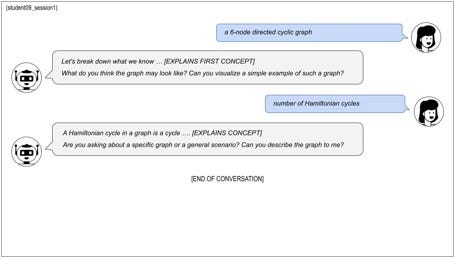
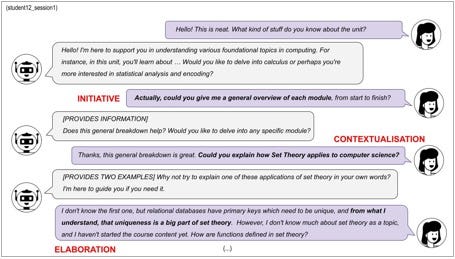
The two exchanges above are typical of the patterns we saw. The difference was not the technology; both students had access to exactly the same chatbot. The difference was what the TEQSA-commissioned paper calls hybrid metacognition: the regulation of thinking within a human and AI system.
The first student was collecting answers. The second was running a deliberate learning process and positioning the AI inside it, deciding what to ask, what to challenge and what to carry forward.
Neither student is doing anything wrong. What the contrast shows is how much students vary in their self-regulated learning skills, and how directly that variability shapes what they get from AI. Recent work points the same way, where stronger students used a Socratic chatbot to set goals and work through material while weaker students used it mainly to seek information.
From product to process
This is why the conversation needs to move beyond AI literacy alone. Knowing how to operate today’s tools matters, but tomorrow’s tools will look different, and the capabilities that transfer are the ones that let students evaluate information critically, manage what they offload to a machine, recognise when productive struggle is doing its job and keep adapting across a career. None of that develops by accident. It develops in learning environments where planning, reflection, judgement and self-regulation are explicit parts of the design rather than hidden expectations.
For anyone wondering where to begin, the TEQSA paper offers five propositions for policy and practice, but the most immediately actionable is the shift toward process-focused assessment. It can start small. Ask students to document one decision they made while working with AI: what they accepted, what they rejected and why. A single reflective checkpoint like this will not solve the assurance of learning on its own, and it will not replace secure assessment, which still has a role. What it does is make a student’s reasoning visible, and visible reasoning is something we can actually teach to, give feedback on and build from. Scaled across a curriculum, that is the difference between knowing what students produce and understanding how they are learning.
The first phase of higher education’s response to generative AI rightly protected the integrity of assessment. The next phase has to ensure that meaningful learning keeps occurring, for every student, in a world where AI can supply the products of learning. That means attending to the process itself: how understanding developed, what changed along the way and what the student did to make it happen.
That is not about preparing students for the tools of 2026. It is about graduates who remain capable of learning, exercising judgement and acting with intention, no matter what the technology becomes. If we can achieve that, AI will not have diminished learning. It will have pushed us to design learning environments that keep agency where it belongs: with the learner.
Dr Paula de Barba is Senior Lecturer, Monash Education Academy, Monash University
A note on how this piece was written
The ideas here rest on far more than one author. The TEQSA paper behind this piece was intense group work which I co-led with Professor Jason Lodge (University of Queensland and NeededNow Managing Editor): a framework argued over, drafted and reviewed by nineteen colleagues across eight universities over many months. Nothing above should be read as mine alone except the opinions, and any errors. The Socratic chatbot study was likewise collaborative, designed and implemented at Monash Online with Associate Professor Anuja Dharmaratne (Monash University) and Jesse Keenan and Matt Kelly (Online Education Services). The chatbot was built on Cogniti, the platform developed by Professor Danny Liu (University of Sydney), who generously enabled our access to it.
The writing of this piece had its own process, which, given the topic, seems worth being upfront about. I shaped the narrative then produced a first draft in conversation with ChatGPT (3.6-Sol), restructured and rewrote it with Claude (Fable 5), ran a further review and redrafting pass with Gemini (3.5 Fast then Thinking), then returned to Claude (Fable 5). The final step was mine alone. The judgement about what to claim, what to cut and what I actually believe stayed with me. Which is, more or less, the argument of this piece.