
No time like extra time: Rethinking flexibility for part-time students
Kelly Linden, Sarah Teakel and Jacquie Tinkler, Charles Sturt University
In August, we wrote a piece, Putting Part-Time Students on the Map, to introduce initial findings of Kelly’s 2025 ACSES Equity Fellowship – Helping part-time students to succeed in a full-time world. We highlighted the importance of extensions in supporting part-time students as a relatively easy and flexible way of accommodating their various needs. While we continue to map broader support strategies for part-time students, flexible extension policies are emerging as a particularly impactful and immediately actionable form of flexibility for students.
Through our interviews and survey responses with Australian part-time students, we have learnt that, beyond academic pressures, students experience challenges associated with the cost of living, managing a work life balance and childcare. Additionally, not everything can be planned for, such as that last-minute report due at work that requires your immediate and full attention. We have found that students often struggle to evidence their need for an extension, and don’t always feel comfortable sharing their issues. Students in rural areas have told us that it takes 2-3 weeks to get a GP appointment and there is no bulk billing available to them.
“It’s not always possible to just get an appointment for the required evidence quickly.”-Student
Approximately 15% of part-time students who completed the survey have reported that they have a disability or condition that impacts their study but are not registered with their university’s disability and inclusion office. This is sometimes due to the prohibitive costs and wait times associated with obtaining a diagnosis. There are also reports that students who are first-in-family to attend university often do not know that extensions even exist (Ruesch & Sarvary, 2024).
“Applying for special considerations is stressful. The person assessing my application does not know me or my circumstances… It’s also extra steps and paperwork when I’m already at capacity for what I can get done in a day. I’m burnt out, exhausted, and in survival mode. Facing the special cons system often makes me want to give up and accept a failure.” Student
In 2023, Charles Sturt University introduced an automatic 7-day extension for one assessment item per unit, per semester. No-questions-asked. No paperwork. No doctor’s notes. No unnecessary cost. No awkward emails. Just a little breathing room.
The demand is clear. In 2024, nearly 20,000 students accessed almost 60,000 no-questions-asked extensions, which was approximately 70% of all students with an active enrolment. Survey responses (n=341 part-time, n=160 full time) indicated that the automatic 7-day extension provided flexibility in managing work, family and study. Students reported the particular advantages of the no-questions-asked extension were that it helped manage competing demands of work, family, and caring responsibilities and their stress levels, as well as enabling them to complete the assessment to a higher standard and to space out assessments with competing due dates. Importantly, students appreciated that they did not have to disclose their illness or individual circumstances.
“The 7-day extension has greatly improved my ability to complete assessments. I do not qualify for SAP [student access plan] as my disability identified by my GP is extremely expensive to completely diagnose officially which I cannot afford.” Student
A particularly interesting finding was that students with disabilities registered with our Disability and Inclusion Team who did have an access plan also used the automatic extension rather than contacting lecturers to negotiate for extensions, despite their plan allowing them to take extensions. It removed the need to disclose they had a study access plan, and the stress of needing to contact their lecturer to negotiate dates.
Are our policies out of touch?
Charles Sturt continues to have a formal policy for longer extensions and other special consideration requests that requires documented evidence. However, students reported issues with this formal extension policy:
“Frustrating and if it’s denied from lack of evidence you have no option but to fail the subject sometimes.” Student
This is the policy setting in place at most other Australian universities. As noted above, the two main reasons that part-time students gave for requesting a no-questions-asked 7-day extension were to manage work demands and to manage stress and mental health. These are explicitly stated in most policies as reasons that students cannot apply. The third most common reason students gave for seeking an automatic extension was to manage caring responsibilities. While this is technically a permitted policy reason to apply, the very strong wording of “Family/personal reasons – including death or severe medical or personal problems” will not resonate with a mum who has a child with a 24-hour bug or a dreaded 48-hour daycare ban.
Does everyone love it?
The 96 academic staff who completed the survey were less enthusiastic about the no-questions-asked extension policy.
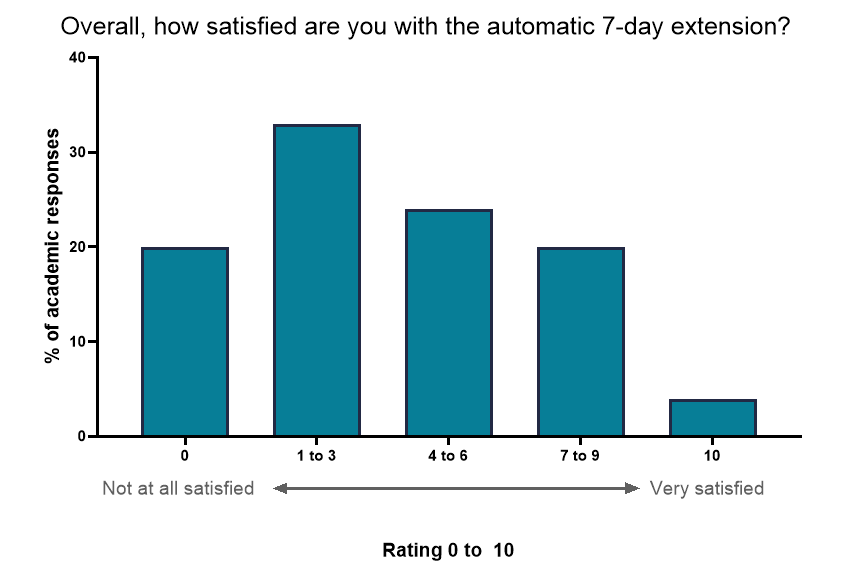
However, the academic staff who were in favour of the policy fundamentally understood the intent, recognising the value of providing assessment flexibility for students.
“I think a one off 7-day extension per subject/per session is good. It still enforces time management for all other assessments.” Academic
Staff concerns were largely due to workload related changes in marking management, student accountability, potential effects on student learning, and that students would not learn time management skills, particularly in the context of their future professions. Some felt that it removed the opportunity for students to flag the need for academic support:
“Some students who were struggling and needed extra support used the auto-extension, but because I didn’t know the reason, I wasn’t able to offer them appropriate support.” Academic
This indicates a significant misalignment between students’ needs in accessing the no-questions-asked extension policy and academics’ concerns. For example, academics’ assumptions that students would not learn time management skills, or had poor time management, were the opposite of students’ reported use. We found most students were using it as a part of their time management strategies.
Where is the sector heading?
We are not the only university which has realised flexible extensions are important for student success and wellbeing. A quick glance at policy libraries across the sector indicates that almost half of all Australian universities have some form of short extension that does not require documented evidence, varying from 2, 3, 5 and up to 7 days. The way they are applied however varies. It may be a grace period where no late penalty is applied; a simple form that is automatically approved; or an application that requires a reason and approval by a unit-coordinator. And, the jury is out on what is the ideal length of an extension that balances students’ needs with academic workload and marking schedules. One clear benefit of a 7-day extension is that it will always include a weekend, critical for many part-time students.
“Automatic extensions where you don’t need to contact the lecturer have been a game changer.” Student
A little extra time.
Here, we have highlighted the importance of flexibility for part-time students and the benefit that a single policy change can have. Changes to support students’ study do not always have to be complex or costly. Sometimes, it’s as simple as giving students a bit more time.
Because sometimes, a little extra time is exactly what students need to succeed.
This work is funded by the Australian Centre for Student Equity and Success (ACSES)
Associate Professor Kelly Linden is a 2025 ACSES Equity Fellow at Charles Sturt University
Dr Sarah Teakel researches student support and success at Charles Sturt University
Dr Jacquie Tinkler is Sub Dean, Learning and Teaching, at Charles Sturt University